
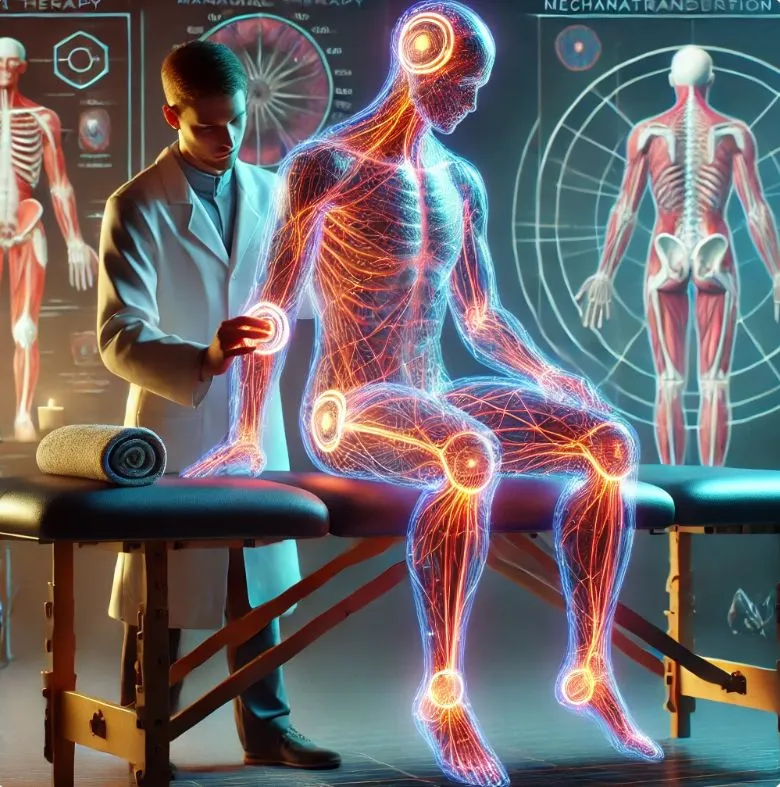
How Soft Tissue Mobilization, Myofascial Release, Cupping, and Joint Mobilization Spark Cellular Healing
Just like your car needs regular maintenance to perform at its best, your body needs skilled manual therapy to stay resilient, mobile, and pain-free. You wouldn’t wait until your engine seizes up to visit a mechanic — and you shouldn’t wait until pain or dysfunction sets in before giving your body a tune-up.
At the core of this maintenance strategy is a powerful biological process called mechanotransduction — your body’s way of turning movement and pressure into healing at the cellular level (Khan & Scott, 2009;Kacprzak & Stańczak,2024).
Mechanotransduction is how your tissues translate mechanical force into biological action. When you apply soft tissue mobilization, stretching, or joint motion, your cells receive those signals and respond with(Citeroni et al., 2020; Kim et al., 2024):
This complex communication doesn’t happen in isolation — it’s influenced by brain-body interactions, inflammatory states, and tissue adaptability. Langevin (2021) emphasizes that understanding musculoskeletal pain requires reconnecting the brain with peripheral tissue health, especially through practices that combine movement and awareness.
“It’s like plugging your body into its own biomechanical software update — restoring balance, reducing stiffness, and enhancing performance from the inside out.”
Soft tissue mobilization (STM) applies strategic compression and shear forces into muscle and fascia, stimulating integrins and mechanosensitive ion channels. These signals reduce inflammation and increase protein turnover in muscle
“Think of STM like flushing out old oil and adding high-performance fuel.”
MFR targets fascia with sustained tension to stimulate fibroblasts — your body’s collagen architects. When activated, they remodel connective tissue and reduce fibrosis (Kacprzak & Stańczak, 2024).
“This is like aligning your suspension system — smooth, responsive, and fluid.”
Cupping applies negative pressure to lift the skin and fascia, delivering tensile stress that stimulates fibroblast migration and matrix remodeling (Harper et al., 2024).
“Think of it as vacuum-sealing a sluggish system to restore flow and flexibility.”
Joint mobilizations apply small, graded movements that activate cartilage cells (chondrocytes) and improve synovial fluid production (Wilke et al., 2018).
“Like wheel alignment, it keeps your structure in balance and ready to move”.
When you receive soft tissue work, cupping, or mobility therapy, you’re not just relaxing — you’re activating deep biological repair systems that reduce pain, restore tissue function, and boost resilience.
Mechanotransduction is the art and science behind why manual therapy works — turning touch into transformation.
Integrative researchers like Langevin (2021) advocate for a “whole person” approach to musculoskeletal care — not just targeting local tissue, but acknowledging how movement, fear avoidance, and neuroplastic changes in the brain all interact with soft tissue health. Manual therapy fits into this bigger picture by addressing both the biological and behavioral loops of chronic pain.
Whether you’re recovering from injury, managing chronic pain, or just want to stay in motion, soft tissue therapy is your tune-up — activating your body’s own systems for resilience, repair, and optimal performance.
At Naperville’s Resilient Acupuncture+ Mobility, we specialize in soft tissue mobilization and evidence-based movement therapy that speaks your body’s language. Ready for a tune-up that goes beyond the surface? Book your session today.